
God’s Providence and Your Mission, Part 2

My story is unique, as is your story. It is a story that has unfolded under the providential care of the Heavenly Father. I came to faith in Christ as an 8-year-old growing up in a Southern Illinois coal town. I was baptized by immersion soon after and became a member of a local church. The next year, something happened that shaped and set the course for the rest of my life. I went to a mission camp. There I sat under the spell-binding teaching of Southern Baptist missionary legend, Dr. John Abernathy.

Dr. Abernathy was then on his final furlough before retiring to Hot Springs, Arkansas. He was a missionary is his sixties. I was a boy barely nine years of age. Dr. Abernathy served the later years of his missionary career in Korea, but his legacy was established during his time of service in China before the communist takeover. That week at missions camp, he told me stories of his life among the Chinese, his being shot by Japanese soldiers and being saved by Chinese Nationalist soldiers, and, most importantly, of his involvement in one of the great revivals of the 20th century, the Shantung Revival. As a child, I spent that week with him in rapt attention asking him questions and listening to his stories. He placed in my young heart a passion for the Great Commission. When my mother came to pick me up from the camp, he walked with me to the car, placed his hand on my head and said to her, “Mrs. Johnson, I believe this young boy might be called to Christian missions.” From that time forward, I never had any question about it. I was made by God to be involved in His mission to the nations. It was then I knew that I had a call from God.

Providentially, life went on. I entered the ministry, was married, and started a family. However, the call to missions was there, lying dormant below the surface of my life waiting for the chance to bloom and grow. That reaffirmation of my call came at 27 years of age, at about the time of the birth of my son. Stephen was born with some health challenges. Caron and I did all that we could to care for him and nurture him with our limited resources. However, to my disappointment, I was told by our denominational sending agency that we could not be appointed due to his health condition and our indebtedness paying his medical bills. I had given up all hope of serving in international missions. It seemed that the door had been irreversibly closed. Then, God in His gracious providence renewed my call and acted by His power. Two things happened in a short period of time: God said to go to the nations and my son’s health was restored.

One evening, Caron and I were visiting with Steve and Deanne in Hopkinsville, Kentucky.  (Be sure to go back and read Part 1 of this Blog post, if you missed it last week.) As we were about to leave, Steve, knowing my love for reading, said: “Hey, I have a book, that I would like for you to read. It is about one of your Southern Baptist missionaries who served in China.” I thanked him for the book, took it home and began reading it. The book was titled, The Shantung Revival. To my surprise, on the inside cover was the handwriting Dr. John Abernathy. He wrote a personal note to the recipient of the book.  (Who that original recipient was, and how it got from that person to my friend Steve, I will never know.) Not only that, but as I turned the pages, Dr. Abernathy’s notes were in the margins of the text. Literally, on every page, it was as if I were hearing his voice from my childhood speaking to me again. At the same time, I heard God speaking to me, telling me that His call had not changed. That book came to me at the time of my deepest despair by the hands of a friend. Why at that time? I have only one answer, God willed it. I told Caron that I did not know how, but I knew that God wanted us to be missionaries. To do that, she reminded me, we would need a miracle to heal our son, which is, in my opinion, precisely what happened next.

Our son, whose emergency C-section brought him into the world a couple weeks ahead of schedule, had been subject to allergies and lung infections from birth. He was subjected to a battery of tests and found to be allergic to host of things. Allergy therapy followed, but he was always dogged by the specter of pneumonia, of which he had recurring bouts. Slowly, we noticed improvements and two and half years later we decided to reestablish contact with our denominational mission agency. The doctor there remembered our case and requested an update on our son’s present health status. To my amazement, the doctor called us into his office and shared with us: “Mr. and Mrs. Johnson, your son seems to have marvelously recovered. It appears that he will no longer need on-going allergy therapy.” Believing all things are under God’s control, I have no doubt that my son’s treatment and healing was superintended by the gracious providence of God Almighty.

God has taught me the following lessons from my experience, and I would suggest that they are applicable to your life as well:

  • God has a plan for your life. He really does. You are not here on accident. That plan might or might not involve you moving to another country. However, it will involve your glorifying God wherever you are in whatever circumstances you are. For now, you are where you need to be. Learn the lessons that He has for you where you are. “Don’t get discouraged if the task or ‘call’ does not come immediately. Remain faithful in what He has told you to do, no matter how small or seemingly insignificant it may appear.[1]
  • Put yourself in places where can God can speak to you. For me, it was at a missions camp. For you, it might be at a local church, a special conference, etc. However, don’t think it is only a special few that have providential encounters with God Almighty. God speaks to us all. It is incumbent upon us to learn to clearly hear the voice of the Good Shepherd. Be involved in missions though your local church. God speaks most clearly when we are engaged in His work.
  • You have not been abandoned; you are not an orphan. No one has helped me more in this area than Jack Miller. Miller uses the helpful check list in order to help to assess our hearts:
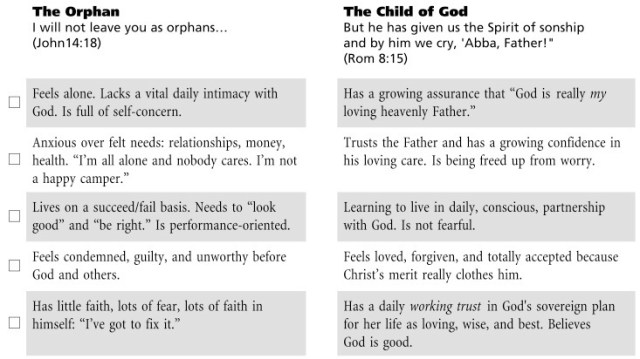
orphan son checklist

“If you’re a Christian, you’ve been adopted. God is your Father. You have all the benefits of sonship. You are now a son or daughter of God” http://www.justinbuzzard.net/2009/12/21/orphans-vs-children-checklis/. If this is the case, and it is if I am a Christian, I can never give into despair. I am not an orphan alone in this vast Universe. I am an adopted child of the Great King of the Universe and He will accomplish His purposes in my life.

God has a purpose for your life and He is working to accomplish it. If the Father has spoken to you in the past and you are still waiting for Him to fulfill His Word in the present, do not lose heart. The purposes of the Lord will stand. His providential purposes are sure and He is always right on time, His time. Dr. Henry Blackaby in his book, Experiencing God, quotes  Charles Spurgeon: “When we cannot trace God’s hand, we must simply trust His heart.”

A happy and blessed New Year to all!

Mark & Caron

[1] Duke, R. D. (2010). God’s Enabling Grace in the Path of Suffering. The Founders Journal: Suffering and Glory, Spring, (80), 25.


 

God’s Providence and Your Mission, Part 1

The year 2015 ended with the special pleasure of having a visit in our home with long-time friends, Steve and Deanne Turley. Steve and Deanne are veteran Assemblies of God missionaries who have served in Belgium for many years. The time together with them reminded me of everything special about Christian friendships that the years cannot dim: free-flowing conversations that are serious and substantive. Conversations that are honest, yet full of confidence in God’s providential mercies. These providential mercies have been made evident in years past and will certainly continue to be made evident in the upcoming years, including the year of 2016. Time with Steve and Deanne reminded me of the special place this couple has had in our lives and how God providentially used them to send us to Brazil 23 years ago. The same providence that has been at work in my life is at work in your life as well. Each of have a mission to accomplish. This post is my attempt to assure you that, “He who began a good work in you will complete it.” How? I cannot say. Will He? Of this, I am certain. My own story is a testimony to His faithfulness. Before telling my story, let me define briefly two important concepts, mission and providence.

Providence. God’s providence is defined by the Westminster Divines in the following way: “God’s works of providence are, his most holy, (Ps. 145:17) wise, (Ps. 104:24, Isa. 28:29) and powerful preserving, (Heb. 1:3) and governing all his creatures, and all their actions. (Ps. 103:19, Matt. 10:29–31)[1]” Simply stated, providence is the teaching that God has all things under His control, including the details of my life, for good and for ill. Because it is God who is control, I can be sure of three things:

  • I can trust God’s providence because He is all powerful. The God who made the vastness of the universe can and does control the sometimes seemingly chaotic details of my life and your life.
  • I can trust God’s providence because He is all wise. I think that I have an idea as to how the universe should be best governed, but the fact is that I am woefully limited by my finite sinfulness. God knows no such limits. He really does know what is best for me and this vast universe that He created.
  • I can trust God’s providence because He loves me. Jesus said that He would not leave us as orphans. We are His and He is ours. In all things, we have the confidence that He will never leave us or forsake us.

Mission. What is mission? There are a host of understandings of what this simple word means. Those understandings range from the simple idea of being sent to do a task to the possible actions and activities that might characterize and compose that task. However, for the purpose of this blog post, I am using a simpler understanding of the term, a definition of that comes from the world of leadership training. Your mission is what you should be doing, what you should be doing in every area of your life.

The word mission is derived from the Latin word, “missio” to be sent. This in turn begs the question: Sent to do what? What should I be doing? Answer that question and you know the mission for your life in every area of your life. Speaking from the perspective of Christian ministry, Aubrey Malphurs gives this helpful definition: “A mission is a broad, brief biblical statement of what the ministry is supposed to be doing.”[2]

Substitute the words family, person, company, organization, etc. for the word ministry, and it will make no difference. The operative word is “should.” Your mission, before God, is what you should be doing in your life and with your life.

This inevitably leads to a couple of basic questions:                                        “How I can know what is my mission?”                                                                       “How can I remain faithful to that mission once that I know it?”

I will address the question of how you can know your mission in a separate post. But for now, I assume that you already know what your life mission is but you are facing barriers that seem insurmountable in seeing that mission accomplished and become a reality. This was the case in my life when God used Steve and Deanne to rekindle my call to missions. I will share more about that chapter in our pilgrimage to missions in the next blog post. Be sure to check back next week for Part 2 of God’s Providence and Your Mission

[1] The Westminster shorter catechism: with Scripture proofs. (1996). (3rd edition.). Oak Harbor, WA: Logos Research Systems, Inc.

[2] Malphurs, A. (1998). Developing a dynamic mission for your ministry (p. 33). Grand Rapids, MI: Kregel Publications.

Christmas and the Mission of God, Part 2

In part one of this article we looked at three points of concern about the celebration of Christmas, the conclusion many leading Anglo-Saxon Protestants reached about Christmas observance, and some application questions based on those well justified concerns. Now let take it a step further.

If the concerns about Christmas are as grave as those mentioned, why should it continue to be practiced by convictional evangelicals today?

I believe the answer is a question of Great Commission concern. Christmas is an example of missiological concern and historical contextualization. First, let’s briefly define contextualization.

Contextualization is defined by Dr. M. David Sills as:

…the process of proclaiming the gospel and living as the church in a modern cultural context.[1] … No one today lives in a first-century Palestinian cultural context, so every modern Christian contextualizes the gospel and the church in a cultural setting fundamentally different from the world of the Bible. However, most people don’t realize they are doing it.[2]

Contextualization is the process by which the Gospel is proclaimed and assimilated in cultures different from the biblical culture, and often times vastly different from the culture of the one sharing the Gospel message. This happens with greater frequency than is often recognized.

Musical preferences are usually the easiest way to see contextualization at work in most ministry settings. For example, some would argue that within their cultural reality, Southern Gospel is the best way to musically express Gospel truths. Others put forward the case that within their context, Contemporary Christian forms of music are better. Which musical option is correct, Southern Gospel or Contemporary Christian? If fact, both of these may be right and/or both be wrong. At this point, the cultural context determines what is the best strategic approach to be used. Some ministry contexts may favor large scale Christmas cantatas during the Christmas season. Other contexts may not favor Christmas cantatas at all, but rather multiple Christmas Eve services using classical music in order to reach their communities. In each case, musical style is a servant to the greater cause of relevant, comprehensible Gospel communication. The point to remember is that contextualization is always happening, whether we realize it or not. As it is always happening, it can be said that it has always been happening, which helps us better to understand the missiological origins of Christmas.

Before the conversion of the Angels and Saxons in what is now modern England, there was some religious observation of the birth of Christ in the Roman world. However, it was not tremendously emphasized in the ancient Church. Clearly, the focus was on Resurrection Sunday, which is now called Easter. Dan Groves gives this helpful summary:

Dionysus Exiguus, a sixth century monk, who was the first to date all of history from December 25th, the year of our Lord 1. Other traditions gave dates as early as mid-November or as late as March. How did Christmas come to be celebrated on December 25th? Cultures around the Mediterranean and across Europe observed feasts on or around December 25th, marking the winter solstice. The Jews had a festival of lights. Germans had a yule festival. Celtic legends connected the solstice with Balder, the Scandinavian sun god who was struck down by a mistletoe arrow. At the pagan festival of Saturnalia, Romans feasted and gave gifts to the poor. Drinking was closely connected with these pagan feasts. At some point, a Christian bishop may have adopted the day to keep his people from indulging in the old pagan festival, http://www.christianity.com/church/church-history/timeline/301-600/the-1st-recorded-celebration-of-christmas-11629658.html?fb_action_ids=10153099175722364&fb_action_types=og.likes

It needs to be remembered that these first historical observances of Christmas were within the bounds of the Roman Empire among Latin speakers disposed to accept the Roman worldview. What about those from beyond the pale of the Roman empire? What about the Barbarians?

The first major group of Barbarians to convert to the Christian faith were the Angels and Saxons, the Anglo-Saxons. Their conversion occurred roughly around A.D. 596, or about 10 to 15 years prior to the founding of Islam in 610. Upon their conversion, the missionary to the Angels and Saxons, Augustine of Canterbury, was faced with a simple, but profound question: Now, what? This people had converted, but had no previous background or exposure to the Christian worldview or to the Christian faith. Augustine of Canterbury wrote to Pope Gregory seeking orientation. Gregory’s advice explains why and how Christmas, and other aspects of Christian tradition, developed among these newly converted non-Latin/non-Roman peoples. Gregory responded to Augustine with these words:

The heathen temples of these people need not be destroyed, only the idols which are to be found in them.… If the temples are well built, it is a good idea to detach them for the worship of the true God.… And since the people are accustomed, when they assemble for sacrifice, to kill many oxen in sacrifice to the devils, it seems reasonable to appoint a festival for the people by way of exchange.[3]

Missiologists, like Johan Bavinck, describe this attempt to connect deeply with a given culture with no previous association to the Biblical message as possessio, literally “take possession of”. Gregory oriented Augustine to use and preserve pagan festivals and places already familiar to the Angels and Saxons and re-invest them with Christian meaning in order that the Gospel message might naturally take root in a culture that had no previous biblical tradition or awareness. For this reason, a previous pagan holiday, December 25th, became servant to a greater Master, the Gospel of Jesus. In this way, newly converted persons could understand the Gospel within their own cultural context. Christmas was established as a holiday to teach people within their cultural reality the most profound of truths: Christ’s incarnation and the importance of it.

That leads us to the next question:

Can a Christian partake in Christmas with a clear conscience?

I believe they can with this caveat: they must be keenly aware of who is converting whom.

Christmas exists for Christians to teach others, including their families, the importance of the incarnation and its implications for each person. If this occurs, Christmas fulfills its original missionary purpose. Christmas is well kept. If it does not occur and Christians find themselves drifting slowly in the direction of banal, secular consumerism, there is good reason to question if the holiday is fulfilling its original intended purpose, “to detach them for the purpose of the true God”. If a Christians finds their observance of Christmas taking them further from Christ and the Gospel (not closer), they should consider the need to re-calibrate their spiritual lives.

How can one best celebrate the Christmas season?

Here are our suggestions:

  • Remember what Christmas is about. It is not primarily about children, family, or the exchanging of gifts with those we love. These things are not bad; however, that’s not what Christmas is really all about. Christmas is about the celebration of the Incarnation. Anything that detracts from that is a distraction, not a helpful addition.
  • Can Christians cultivate the imaginary aspects of Christmas without deeply compromising the actual intent of the Christian holiday? Certainly, the Dutch Christian experience of Sinter Klaas shows that it can be done. The playful, whimsical element of Christmas need not be denied, and can be enjoyed by all, but should be held in reasonable check. When Santa looms large and the incarnation looms small, you already know the Christmas celebration has become unbalanced.
  • Maintain the giving of gifts within the limits of good Christian stewardship. Simply stated, incurring indebtedness purchasing Christmas gifts is always a bad idea. Set a budget and stay within it. You might enjoy focusing more on giving gifts that are simple, but reflect creativity and genuine artistry: sewing, baking, wordworking, painting, etc. Perhaps, some might want to give the gift of time and labor in helping with special projects. There are some gifts that money can’t buy. Never forget the gift of a good song after a special Christmas meal.
  • Invest in the life of your local church during the Christmas season. Make sure your local church gets time, effort, and energy that is needed during this busy time of year. Few things are more tragic than Christians so busy with secular Christmas activities they neglect supporting the celebration of Christmas in their local church. Rather than being a part of the on-going cultural discussion about the War on Christmas, exercise your First Amendment right and celebrate Christmas heartily and fully where you can do it with the full blessing of God and man, in your local church. Local churches, no matter how they choose to celebrate Christmas, need the presence, participation, and support of God’s people.
  • Remember the lost at home and abroad during the Christmas season. Hymn writer Keith Getty recently said as the culture becomes more secular the importance of Christmas as an outreach event in the local church becomes incrementally more important. He is right. Invite your lost friends to participate in the Christmas celebrations in your church.
  • Finally, as you give and exchange gifts, never forget the greatest gift was the gift of God’s Son. As you give to the Lottie Moon Christmas Offering, your gift helps others in different cultures to come to know the grace and hope that only exists in Christ’s Gospel. The work of Christian missions is tasked with sharing the Christmas message among all peoples: Roughly paraphrasing John Calvin, “The Son of God became the Son of Man in order that the sinful Sons of Men might become the glorious redeemed Sons of God.”

Is it really too hard to observe Christmas in this day with the same simplicity Christians have done in centuries past?

No, I don’t believe that is the case. Ask a good question and give a good answer, and the true meaning of Christmas can be kept in its rightful place. I conclude with lines from two of the greatest Christian philosophers, Charlie Brown and Linus:

Charlie Brown: I guess you were right, Linus. I shouldn’t have picked this little tree. Everything I do turns into a disaster. I guess I really don’t know what Christmas is all about.

[shouting in desperation]

Charlie Brown: Isn’t there anyone who knows what Christmas is all about?

Linus Van Pelt: Sure, Charlie Brown, I can tell you what Christmas is all about.

[moves toward the center of the stage]

Linus Van Pelt: Lights, please.

[a spotlight shines on Linus]

Linus Van Pelt: “And there were in the same country shepherds abiding in the field, keeping watch over their flock by night. And lo, the angel of the Lord came upon them, and the glory of the Lord shone round about them: and they were sore afraid. And the angel said unto them, ‘Fear not:”

[Linus drops his security blanket on purpose]

Linus Van Pelt: “for behold, I bring unto you good tidings of great joy, which shall be to all people. For unto you is born this day in the City of David a Savior, which is Christ the Lord. And this shall be a sign unto you; Ye shall find the babe wrapped in swaddling clothes, lying in a manger.’ And suddenly there was with the angel a multitude of the heavenly host, praising God, and saying, ‘Glory to God in the highest, and on earth peace, good will toward men.'”

[Luke 2:8-14 KJV]

Linus Van Pelt: [Linus picks up his blanket and walks back towards Charlie Brown] That’s what Christmas is all about, Charlie Brown.


A very Merry Christmas to all from the Johnsons.

[1] Pratt, Z., Walters, J., & Sills, M. D. (2014). Introduction to global missions. Nashville: B&H. [2] Pratt, Z., Walters, J., & Sills, M. D. (2014). Introduction to global missions. Nashville: B&H.[3] Terry, J. M. (1994). Evangelism: a concise history (p. 49). Nashville, TN: Broadman & Holman.

Christmas and the Mission of God, Part 1

Reasons to Keep Celebrating Christmas

It is said that confession is good for the soul, so here it goes: I am a part of that evangelical generation that actually questioned some time ago, and to an extent still in a healthy way, the wisest and best way to celebrate Christmas. You might be among those who find it hard to imagine in the present cultural moment that there are those of us who have, and still do, question the rightness (yes, even the necessity), of celebrating Christmas.

It is obvious that the Christmas juggernaut continues to roll unabated and gathering ever greater mass and velocity in a rapidly secularizing American culture. “American Christmas” continues to win converts in all parts of the world to a secular, sentimentalist vision of good will and joy to all men via consumerist spending. Christmas is now celebrated in places you would least expect it. It is celebrated in secular, Buddhist Japan and in Islamic Turkey. In these places, and many more, it is seen as a harmless, definitely non-religious, moment for good-hearted family fun. It is this very point that concerned many evangelicals in the past and should still concern evangelicals today.

In light of the rampant secularization of Christmas today, should Christmas still be celebrated by sincere evangelicals?

In all honesty, Christmas’ origins bring with it a wooly and unsavory past. For example, most Bible scholars do not believe that Jesus was born on December 25. Much has been written on this subject. The best article of which I am aware is Colin Humphrey’s “The Star of Bethlehem, A Comet in 5 BC and The Date of Christ’s Birth[1]” Professor Humphrey’s concludes:

The birth of Christ was in the Spring, in the period 9 March–4 May 5 BC. Tentatively the period around Passover time is suggested (13–27 April 5 BC). This date is consistent with the available evidence including a reference in Luke to there being shepherds out in the fields at night. Although today Christmas is celebrated on 25 December in the west and on 8 January in the east, we suggest that the evidence of astronomy, the bible and other ancient literature points to the Spring of 5 BC as being the time of the first Christmas.[2]

December 25 is most likely not the correct historical date for the actual birth of Christ. This leads to some logical questions then:

  • What is so special about December 25?
  • Why is it celebrated as a special date?

December 25 is normally associated with the ancient Feast of Saturnalia. George Fisher wrote in the Princeton Review last century:

In connection with the close of the year there had existed a series of heathen festivals into which the Romans entered with extreme delight. First were the Saturnalia, the jubilee of Saturn or Kronos, which marked the close of farm-work for the year, when the reins were given to merriment, when slaves could put on the clothes of gentlemen, and wear the badge of freemen, and sit at a banquet, being waited on by their masters.[3]

It is a fact that December 25 as a festival date has deep roots in a pagan and sensual past. An evangelical Christian is not to be faulted if they find themselves uncomfortable with December 25 as the preferred date for celebrating Jesus’ birthday.

What is to be made of this Christmas conundrum?

It is not historical; it has become a tool for promoting secularism; it has profoundly questionable origins in a dark pagan past. For centuries Anglo-Saxon/Celtic protestants knew exactly what to make of it: avoid it. Christmas was illegal in Massachusetts until the 19th century. There is little indication that this prohibition provoked an offended outcry on the part of the general American populous. All indications seem to point to the Dutch as being the first to introduce Christmas to the United States in the 17th via the Dutch tradition of Sinterklaas, https://en.wikipedia.org/wiki/Sinterklaas. (If interested in a book for your children and grandchildren, I could not recommend a finer text than Pieter Spier’s “The Legend of New Amsterdam”, http://www.amazon.com/gp/product/B00NI2CR5S/ref=dp-kindle-redirect?ie=UTF8&btkr=1.) B. B. Warfield, one of Americas greatest Protestant theologians, speaks for many centuries of Protestant thought when he wrote just last century:

There is a certain passionate intensity in the way in which Christmas is now celebrated among us. But after all, what can be said for the customs to which we have committed ourselves? There is no reason to believe that our Lord wished His birthday to be celebrated by His followers. There is no reason to believe that the day on which we are celebrating it is His birthday. There is no reason to believe that the way in which we currently celebrate it would meet His approval. Are we not in some danger of making of what we fondly tell ourselves is a celebration of the Advent of our Lord, on the one side something much more like the Saturnalia of old Rome than is becoming in a sober Christian life; and, on the other something much more like a shopkeeper’s carnival than can comport with the dignity of even a sober secular life?[4]

Rather, than cavalierly dismissing Warfield concerns as the theological spirit of Ebenezer Scrooge, we would do well to consider his probing question:  Is the experience of Christmas for many not more akin to a pagan celebration of old than to the values reflective of a sober Christian life?

I offer you some questions for your reflection:

  • Does my conduct during Christmas reflect my Christian confession? The fact is that Christmas is often the occasion for some notoriously bad behavior.
  • Do my fiscal expenditures reflect my Christian commitments? For some, Christmas is a time in which families enter further and further into consumer debt. At times, actual purchases of some products (often media related) actually undermine the very beliefs and values reflected in the Cristian understanding of Christmas.
  • Do my time commitments during Christmas reflect my Christian commitments? Yes, Christmas is a wonderful time for families to be together. Yes, it is a special time for children. But, neither family nor children is to be the primary focus of Christmas. It is the worship of and the reflection upon the Incarnate Lord that should be the primary focus of the Christmas season. Make sure that you give time to your local church to be fully involved in its life during this Christmas Season.
  • Finally, does my experience cause me to treasure Christ more or to treasure my treasure more? How you answer this last question determines what you should make of Christmas as you look to the future.

What then are the conclusions to be drawn? I invite you to read the second part of this article, which will be posted in the next couple of days. If you find this helpful, feel free to share it with someone who might find it to be of interest.

God bless you and Merry Christmas,

Mark and Caron

[1] (1992). Tyndale Bulletin, 43(1), 30. [2] (1992). Tyndale Bulletin, 43(1), 55–56.[3] Fisher, G. P. (1880). The Old Roman Spirit and Religion in Latin Christianity. The Princeton Review, 1, 167.[4] Warfield, B. B. (1903). Historical Theology. Review of WEIHNACHTEN IN KIRCHE, KUNST UND VOLKSLEBEN by Georg Rietschel. The Princeton Theological Review, I(1–4), 490.

Do you have what money cannot buy?

“You are never rich until you have something that money cannot buy.”

The Beatles once sang, “money can’t buy me love”.  MasterCard commercials remind us that certain experiences are “priceless”. There are some things we simply cannot be expressed monetarily.

Recently, I attended a missions banquet where items were being auctioned off and the proceeds directed to the Lottie Moon Christmas Offering. The auctioneer reminded folks that the items they were buying were not really worth the price, but the cause was a worthy one. He reminded folks that they have something that money cannot buy and the Good News they have needs to be shared with others. His words words struck a chord within my American soul. As an American, I struggle with ingratitude. I know that there is more and I find myself wanting. It does not matter that I know how much less others have, my soul wants more. J. R. R. Tolkien described this condition as “dragon sickness”, a heart driven by “delusional greed” http://www.desiringgod.org/articles/how-to-fight-dragon-sickness.  In that article, David Mathis gives the following definition of greed:

Greed is our inordinate desire, our excessive love, for wealth and possessions, for money and the things money can buy — and even for self-esteem, security, status, and power. Greed’s object is money and things, but it is not to be identified with those things. Greed is a misplaced craving in the heart. It is good desire gone wrong. God made us to have and to hold, to desire possessions and things as his creatures in fitting relation to him. The problem of greed is not that we desire things, but that our desires are misdirected and out of proportion.

We desire success, even riches. However, many people feel they never  fully attain either. Why? Quite simply, the human soul seeks for that which cannot satisfy. Sin stained hearts are filled with misdirected cravings. It is only when human hearts find that which money cannot buy that souls find their deepest satisfaction. Saint Augustine famously wrote in the Confession, “Thou hast made us for thyself, O Lord, and our heart is restless until it finds its rest in thee.” We were made to know God. He has placed us in this world.  Bishop J. C. Ryle says it well, “You were placed here to train for eternity.” This is the key to true joy in this world: find your joy in God, the Gospel, and the mission of God to All Peoples in All Places. If you do this, you will be rich. You will have that which money cannot buy. You will have joy in the God of the Gospel.

Live simply and give generously.

When you consider giving that makes an eternal impact, I would ask you to consider giving to the International Mission Board’s (IMB) Lottie Moon Christmas Offering (LMCO), http://www.imb.org/main/lottie-moon/default.asp. Your generous sacrificial giving to the LMCO is important for three simple reasons:

  • The LMCO is essential. Funds from the LMCO are essential for Great Commission advance. Without these funds, the work of International Mission Board (IMB) field missionaries grinds to a halt.
  • The LMCO is effective: 100% of LMCO funds are used for Great Commission ministry among the nations. No funds are used for administrative costs. The monies go to where the needs exist, among the peoples of the world.
  • The LMCO is efficient: 100% of funds given go to fund ministry expenses for field missionaries. There is no administrative or organizational overhead. There is no middle-man. Administrative costs of the International Mission Board are paid for by the Cooperative Program of the Southern Baptist Convention. Your mission offering goes to directly support the work of missions and missionaries.

May this Christmas season your heart find joy in that which money cannot buy, knowing that lives are being changed for all of eternity.

Thank you for your support of the LMCO. From our family to your family, Merry Christmas!

On being a pilgrim people

“But now we are all, in all places, stranger’s and pilgrims, travelers, and sojourners…”—Robert Cushman, Pilgrim Leader, 1622. I read these words on April 21, 2015 while visiting the Pieterskerk Cathedral in Leiden, Holland. My interest in and love for the Pilgrims was first whetted when I read Dr. Timothy George’s Harvard dissertation on Pilgrim Father, John Robinson, John Robinson and the English Separatist Tradition, http://www.amazon.com/John-Robinson-English-Separatist-Tradition/dp/0865540438.

You might remember from grade school history that the Pilgrims fled from England to Holland seeking religious liberty. From Holland, they went and settled in what was to become the Plymouth Colony in present day Massachusetts. For this reason, during a recent visit to Leiden, it was only natural that I searched for the historic remnants of the United States’ spiritual “Founding Fathers” in the European city in which they last had residence before sailing to the New World. That search led me to the plaque on the side of the Pieterskerk and the quote with which I started this post. This quote in turns leads me to three simple questions:

  1. What is a pilgrim people?
  2. Why are we a pilgrim people?
  3. How can we be a pilgrim people?

What is a Pilgrim people? Scripture best answers that question in 1 Peter 2: 11 where Christians are described as “aliens and strangers.” 1 Peter 1:17 states clearly that the believer has a limited and brief time while on earth. It speaks of the believer’s “time of your stay on earth.” The ESV actually translates the word “stay” as “exile”, “throughout the time of your exile.” The Reformation Study Bible boldly states, “The Greek word suggests those who live in a place as unnaturalized aliens, and emphasizes the Christian’s temporary, pilgrim status in the world.”

I have lived in Brazil for 23 years. I love the country. I love the people. I love the culture. I love the food. I am very happy there, but I am not a Brazilian. I am a legal alien. I hope to give the best of my life to my missionary calling. However, I realize that there will be an inevitable end to my missionary ministry when I leave Brazil at the end of my missionary service. I am an alien.What is true of some of us politically, Scripture says is true of all us spiritually. The Greek word translated “stay” or exile is Parepidemoi. Dr. Tim Keller notes about this word the following:

Parepidemoi were citizens of one country and yet full-time residents of another. Their primary allegiance was to another country, and that country’s culture was formative for their beliefs and practices. Yet they lived in their country of residence as full participants in its life. In other words, “resident aliens” lived neither as natives nor as tourists. Though they were not permanently rooted, neither were they merely travelers who were just passing through.

The Pilgrim Fathers, and all mature Christians, have always realized that Christians are citizens of two cities: the City of God and the City of Man. As faithful Christians, we love the City of Man. Personally, I love Brazil and I deeply love the United States of America. Still yet, primarily, I am a citizen of the New Jerusalem, the coming eschatological City of God. Thanksgiving is a special time for the Christian to renew his or her commitment to their primary citizenship, the Kingdom of God.

Why are we a Pilgrim people? We have been made not for time, but for eternity. The Pilgrims’ community suffered a devastating loss of life due to the ravages of sickness and starvation upon their first arriving in the New World. It was tragic circumstances, by any account, but not beyond the realm of the possible in the 17th century. For most of human history, humanity has faced a life that is short, painful, and defined by deep suffering. There is reason to give thanks to God for advances in technology and medicine that have allowed so many in this day to experience longer, reasonably health lives. The problem is that often a spirit of humble gratitude is replaced by a sense of arrogant entitlement that feels, “I deserve to live long and prosper”, to roughly paraphrase Mr. Spock’s Vulcan blessing.

It has been said that American Christians are the first generation of Christians no longer to pray, “Maranata. Come Lord Jesus.” For many, life is so good, that some ask, “how could it get better?” The fact is that many faithful Christians worldwide are suffering the ravages of suffering and persecution. Even in the United States, the future cannot be predicted with absolute clarity. Christians are pilgrims because they know there is only one city whose foundations will never crumble, the City of God. While in this world, we love and serve the City of Man, but Christian hope is ultimately fixed on the unwavering firmness of the City of God.

How can we be a pilgrim people? Or stated otherwise, how does one live a Pilgrim’s lifestyle in this world? Much could be said, but I will share with you only a few suggestions:

  • Live with fiscal frugality. You really cannot have it all, so don’t spend like you can. Your check book and your date book reveal your true priorities. Fiscally invest in what truly matters, people and God’s Kingdom.
  • Have focused priorities. Time is a precious commodity. Scripture says “Man knows not his time.” Because it is limited, time needs to be stewarded carefully. Give time to that which is most important: God and your relationship with him, your family, and God’s work both through your local church and the ministries of your local church and in your community.
  • Be guided by Biblical realism. The Bible views this universe as glorious, yet imperfect. Humanity is made in God’s image, the apex of His creation. Yet, human nature is flawed deeply by sin’s all pervasive presence. This means our lives will not always be what we hope in every area: work, relationships, health, and accomplishments. However, the Christian knows that there are certain levels of perfection, attainment, and satisfaction that will never be attained in this world. For this reason, Christians long for the Coming Kingdom of God.
  • Finally, live in the expectation that the Day will come when you see Christ face to face, either as Judge or as Redeemer. The Pilgrim knows that the sorrows of painful good-byes in this world will be comforted and consoled by the joy of eternal “hellos” to be enjoyed in the world that is to come.

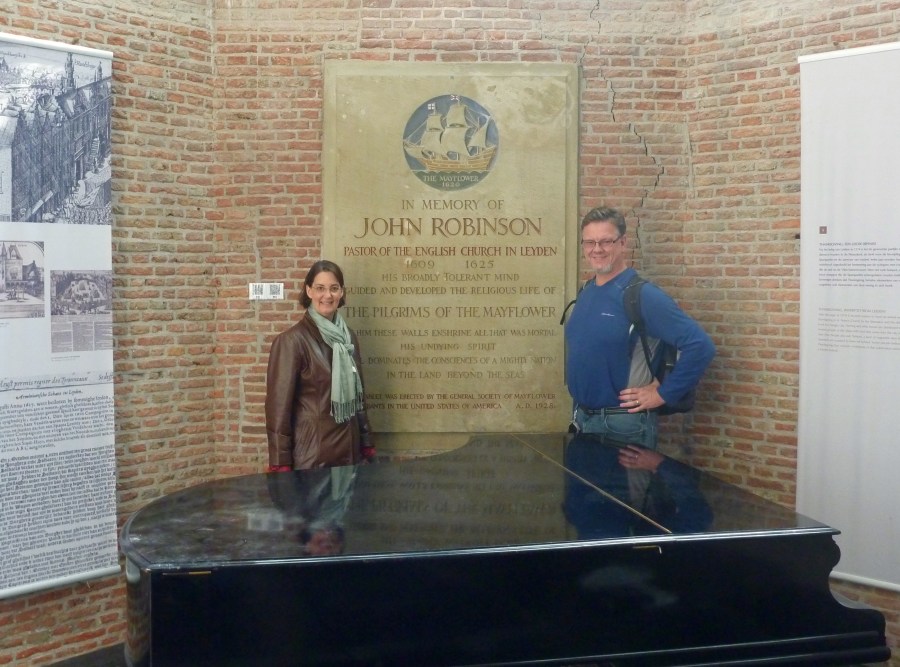
With these things in our hearts, life can be faced with resolution, courage, grace, and faith. I conclude with a brief story of my trying to find the grave of the famous John Robinson, Pastor of the Pilgrims in Leiden, Holland. Caron and I entered the Pieterskerk Cathedral looking for Pastor Robinson’s sepulcher. It should be noted that the Pieterskerk Cathedral was decommissioned as a church in 1976. I searched the entire church, but could not find Pastor Robinson’s crypt. Finally, Caron leaned against a piano. Inadvertently, looking underneath it she said, “I think I have found him.” Sure enough, to my surprise, the spiritual father of the United States was hiding underneath a baby grand piano in complete obscurity in the back corner of the church. Sad? Yes, in a sense it is. However, it is not devastating. This is why we are called to be Biblical realists.

The Pilgrim knows that the forgotten saint in this life will be remembered before the throne of God and will hear the words, “Well done good and faithful servant, enter into your Master’s reward.” Happy Thanksgiving to all.