Looking Back Over 2017

I don’t believe we have ever had a year quite like this one!  We celebrated some pretty significant milestones, worked “away from home” extensively, moved (again!) and continue to help provide leadership for our local congregation and lead weekly small group Bible studies in our home. I apologize for our lack of communication this year.  Our crazy schedule this year has had me struggling just to keep up.  But, I do want you to know that you are never far from our thoughts and prayers.

Allow me to share a bit from a slightly modified Philippians 1:3-12

We give thanks to our God for every remembrance of you, always praying with joy for all of you in our every prayer, because of your partnership in the gospel from the first day until now. We are sure of this, that He who started a good work in you will carry it on to completion until the day of Christ Jesus.  It is right for us to think this way about all of you, because we have you in our hearts and you are all partners with us in grace, both in our teaching ministry and in the defense and establishment of the gospel.  For God is our witness, how deeply we miss all of you with the affection of Christ Jesus. And we pray this: that your love will keep on growing in knowledge and every kind of discernment, so that you can approve the things that are superior and can be pure and blameless in the day of Christ, filled with the fruit of righteousness that comes through Jesus Christ to the glory and praise of God.  Now we want you to know, brothers and sisters that what has happened to us has actually resulted in the advance of the gospel.”

Here are some of the highlights from the year.

FAMILY:

  • On May 6, we gained a beautiful daughter-in-love, Rebecca Mullinax Johnson. Our son, Stephen and his lovely bride now live in Euless, TX.
  • While there for the wedding, we were able to visit our daughter Sarah, son-in-law, Beau, and the two grandest of grandsons, Owen (now 3) and Elliot (soon to be 2). They now live in Princeton, TX.
  • Mark and Caron were able to spend a short time with each of their mothers, both of whom have had several falls, broken bones, and other health challenges this year.
  • In September, we moved to a new apartment. This marked our 12th move in our 32 years of marriage, 7 of those in the last 16 years. I guess it’s no wonder Mark always asks, “Caron, do you know where I can find _____?”
  • In October, we celebrated our 25th anniversary as career missionaries with the IMB. We have been in Brazil all that time (except for the occasional furlough and stateside assignment).

MINISTRY: (Thank you for making all this possible through your prayers and financial support.)

  • In looking back over the calendar, there were 152 day this year where one or both of us were traveling, working away from home! No wonder we are tired!
  • Mark has traveled extensively this year, teaching week long “intensive” courses, where students receive 40 hours of lecture (an entire semester’s worth of material) in one week. Sometimes he writes the course content he teaches in Portuguese; other times, he is the translator for visiting American professors.
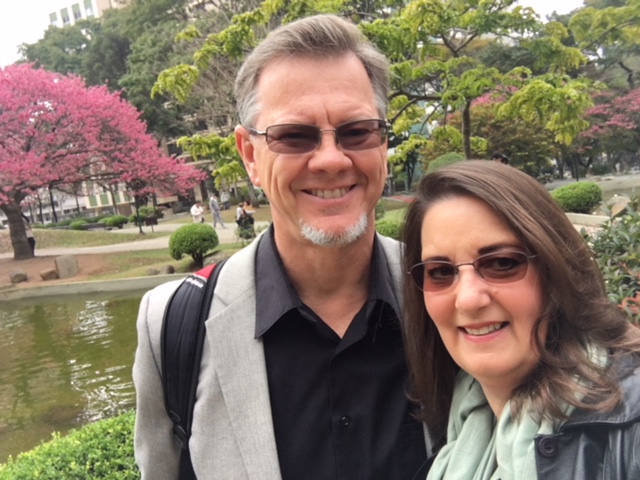
  • Mark has mentored masters level students and has provided orientation for 7 of these students working on their dissertations. Some of his students have included senior leadership in the Brazilian Baptist Home Mission Board, as well as pastors and Brazilian Home Missionaries.pic 3
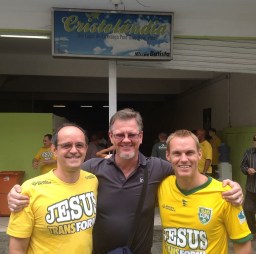
  • Mark accompanied Dr. David Platt, president of the IMB on part of his recent trip to Brazil and had the privilege of translating for him at “Crist-o-landia”, a neighborhood formerly known as “crack-o-landia” (due to the high number of drug addicts who live on the street). Dr. Platt and Fernando Brandão, President of the Brazilian Home Mission Board, were there to give a message of hope to those on the streets and share about the transformative power of the Gospel through Jesus Christ.
  • Mark lectured extensively this year on the 500th anniversary of the Great Reformation, with materials he wrote concerning Baptist History of Missions in light of the Great Reformation. He also has written numerous articles (in Portuguese) for publication in Brazil.
  • Mark taught on-line classes for several different theological institutions, and is currently preparing materials for upcoming classes to be recorded early in 2018.
  • Caron also has been working with Brazilian students who are writing their dissertations in English. She has had the privilege of walking alongside these dedicated students studying and writing in a second language. Caron serves as a reader and editor for these students.
  • Caron traveled on a monthly basis, teaching Theological English at the Litoral Baptist Seminary in Santos, São Paulo.
  • Caron prepared materials for the on-going weekly Bible study that meets in their home, and has had the privilege of mentoring and discipling 8 ladies on a one-on-one basis, in addition to the on-going ministry of the small group.
  • We were saddened by the recent loss of a dear friend (member of our small group) who passed away after battling cancer, and have walked with his family and friends as we have grieved together.

Finally, here are some upcoming ministry opportunities we want you to be aware of for 2018. Please pray about how you can be involved with us. If interested in more details, send a message to caron.johnson@gmail.com

  • We are looking for one or two single girls (min. age 22) or a young married couple (no kids) who would be willing to teach ESL (English as a Second Language) for a semester. No experience necessary. We will provide the training you need.
  • We are looking for a church who would be willing to help host a ladies’ weekend event at the International Congregation of our church. We are looking for a key-note speaker for 2-3 events. We would love to have 2-3 ladies come (a different one could speak at each event) and also have ways for a Sunday School group or the entire church to be involved in helping to host this event for English speakers in the city of Curitiba.
  • We are looking for pastors, seminary students, and laymen interested in partnering with us in teaching initiatives in several different locations in Brazil in 2018.

We wish each of you the Very Merry Christmas and a Happy New Year!

Mark & Caron

Happy Holidays!

Since we missed wishing you a Happy Thanksgiving, Merry Christmas and a Happy New Year earlier, please know that even in our silence you were never far from our thoughts and prayers.

Typically the last quarter of the year is our busiest time of travel, and that was certainly the case in 2016. Since the end of August we were traveling away from home for 97 days, in 15 different cities and in 4 different countries.

You may wonder what we do that takes us away from our home so often. In addition to our local on-going ministry involvement, which we have written about extensively in the past, we have also been involved in numerous training events across the Americas. These training events would not have been possible if it had not been for the generous contributions that many of you have made over the course of year to the International Mission Board. Through regular tithes and offerings (in Southern Baptist churches which participate in the Cooperative Program), through one-time gifts, and through your contributions to the Lottie Moon Christmas Offering, we have had the financial resources to make this kind of wide spread training a reality in 2016. For that, we say “Thank you, from the bottom of our hearts.”

Teaching truth, transforming lives and touching the world—that’s what we have been focusing on in 2016.

Looking back on the year 2016, we can actually count 925 people whom we have taught, mentored and/or discipled. These are not just numbers to us. They are real people. In addition to teaching content, we have spent time together, shared a meal or a cup of coffee together and prayed together. If you keep up with us on FaceBook, Twitter or Instagram you can see that we have taken lots of pictures together as well. These pictures are more than just something to fill space on our social media accounts. They serve as tangible reminders of our precious time together. I think Paul sums it up best in Philippians 3:3-7a

I give thanks to my God for every remembrance of you, always praying with joy for all of you in my every prayer, because of your partnership in the gospel from the first day until now. I am sure of this, that He who started a good work in you will carry it on to completion until the day of Christ Jesus. It is right for me to think this way about all of you, because I have you in my heart, and you are all partners with me in grace…(HCSB)

So, as we have taught truth, we have done so with the vision of lives being transformed—making a difference—and the impact those transformed lives have on the world around them. That, my friends, is something worthy of giving thanks to God for. Truly, it does give us great joy as we pray for those whom we have had the privilege to walk alongside during the year 2016.

As we look back on 2016, we have so much to be thankful for in our own family as well. We added a new member to the family with the birth of our youngest grandson, Elliot James Landers last January. Its hard to believe he will celebrate his first birthday here soon. We also had the privilege of meeting the Mullinax family in November, the parents of Rebecca, our soon to be “daughter-in-love” (Wedding scheduled for May of 2017). We were able to spend a couple weeks of vacation with our kids, grandkids and both our mothers (and even some of our extended family) around Thanksgiving. Returning to Brazil in time for Christmas, we were blessed to be able to celebrate Christmas Eve with precious Brazilian friends and open our home on Christmas Day to others who were far away from their families.

Teaching truth, transforming lives and touching the world—that’s what we continue to focus on in 2017.

Just because it’s a new year, doesn’t necessarily mean our focus needs to change. Granted, some of the details change—location, people involved, topics, etc. But, the purpose remains the same. We continue to use the skill set, talents and abilities God has equipped us with to reach those whom He brings into our path with the Good News, the life transforming news of the Gospel.

How can you be involved?

  1. Continue to pray for us as we make plans for 2017 and the new and exciting challenges in the months to come. (More about that next time.)
  2. Ask the Lord of the Harvest how you can be more personally involved in the ministry of your local church, in your community, and in support of local, national and international missions. Maybe 2017 is the year for you do something you’ve never done before. Ask Him!
  3. Don’t wait to “go somewhere new” to get started. It’s a new year; it’s a good time to begin a new commitment. There is no greater investment you can make than to invest in discipling a new believer. Begin with your most natural relationships: family members, friends, and neighbors. Then ask your pastor if there are others new to your church that you can help to disciple as well.

Check out the article Mark just wrote, “3 Ingredients for Discipling New Believers in Any Context”. You can access it through this link from International Mission Board:

https://www.imb.org/2017/01/03/training-new-believers-in-any-context/


Christmas and the Mission of God, Part 2

In part one of this article we looked at three points of concern about the celebration of Christmas, the conclusion many leading Anglo-Saxon Protestants reached about Christmas observance, and some application questions based on those well justified concerns. Now let take it a step further.

If the concerns about Christmas are as grave as those mentioned, why should it continue to be practiced by convictional evangelicals today?

I believe the answer is a question of Great Commission concern. Christmas is an example of missiological concern and historical contextualization. First, let’s briefly define contextualization.

Contextualization is defined by Dr. M. David Sills as:

…the process of proclaiming the gospel and living as the church in a modern cultural context.[1] … No one today lives in a first-century Palestinian cultural context, so every modern Christian contextualizes the gospel and the church in a cultural setting fundamentally different from the world of the Bible. However, most people don’t realize they are doing it.[2]

Contextualization is the process by which the Gospel is proclaimed and assimilated in cultures different from the biblical culture, and often times vastly different from the culture of the one sharing the Gospel message. This happens with greater frequency than is often recognized.

Musical preferences are usually the easiest way to see contextualization at work in most ministry settings. For example, some would argue that within their cultural reality, Southern Gospel is the best way to musically express Gospel truths. Others put forward the case that within their context, Contemporary Christian forms of music are better. Which musical option is correct, Southern Gospel or Contemporary Christian? If fact, both of these may be right and/or both be wrong. At this point, the cultural context determines what is the best strategic approach to be used. Some ministry contexts may favor large scale Christmas cantatas during the Christmas season. Other contexts may not favor Christmas cantatas at all, but rather multiple Christmas Eve services using classical music in order to reach their communities. In each case, musical style is a servant to the greater cause of relevant, comprehensible Gospel communication. The point to remember is that contextualization is always happening, whether we realize it or not. As it is always happening, it can be said that it has always been happening, which helps us better to understand the missiological origins of Christmas.

Before the conversion of the Angels and Saxons in what is now modern England, there was some religious observation of the birth of Christ in the Roman world. However, it was not tremendously emphasized in the ancient Church. Clearly, the focus was on Resurrection Sunday, which is now called Easter. Dan Groves gives this helpful summary:

Dionysus Exiguus, a sixth century monk, who was the first to date all of history from December 25th, the year of our Lord 1. Other traditions gave dates as early as mid-November or as late as March. How did Christmas come to be celebrated on December 25th? Cultures around the Mediterranean and across Europe observed feasts on or around December 25th, marking the winter solstice. The Jews had a festival of lights. Germans had a yule festival. Celtic legends connected the solstice with Balder, the Scandinavian sun god who was struck down by a mistletoe arrow. At the pagan festival of Saturnalia, Romans feasted and gave gifts to the poor. Drinking was closely connected with these pagan feasts. At some point, a Christian bishop may have adopted the day to keep his people from indulging in the old pagan festival, http://www.christianity.com/church/church-history/timeline/301-600/the-1st-recorded-celebration-of-christmas-11629658.html?fb_action_ids=10153099175722364&fb_action_types=og.likes

It needs to be remembered that these first historical observances of Christmas were within the bounds of the Roman Empire among Latin speakers disposed to accept the Roman worldview. What about those from beyond the pale of the Roman empire? What about the Barbarians?

The first major group of Barbarians to convert to the Christian faith were the Angels and Saxons, the Anglo-Saxons. Their conversion occurred roughly around A.D. 596, or about 10 to 15 years prior to the founding of Islam in 610. Upon their conversion, the missionary to the Angels and Saxons, Augustine of Canterbury, was faced with a simple, but profound question: Now, what? This people had converted, but had no previous background or exposure to the Christian worldview or to the Christian faith. Augustine of Canterbury wrote to Pope Gregory seeking orientation. Gregory’s advice explains why and how Christmas, and other aspects of Christian tradition, developed among these newly converted non-Latin/non-Roman peoples. Gregory responded to Augustine with these words:

The heathen temples of these people need not be destroyed, only the idols which are to be found in them.… If the temples are well built, it is a good idea to detach them for the worship of the true God.… And since the people are accustomed, when they assemble for sacrifice, to kill many oxen in sacrifice to the devils, it seems reasonable to appoint a festival for the people by way of exchange.[3]

Missiologists, like Johan Bavinck, describe this attempt to connect deeply with a given culture with no previous association to the Biblical message as possessio, literally “take possession of”. Gregory oriented Augustine to use and preserve pagan festivals and places already familiar to the Angels and Saxons and re-invest them with Christian meaning in order that the Gospel message might naturally take root in a culture that had no previous biblical tradition or awareness. For this reason, a previous pagan holiday, December 25th, became servant to a greater Master, the Gospel of Jesus. In this way, newly converted persons could understand the Gospel within their own cultural context. Christmas was established as a holiday to teach people within their cultural reality the most profound of truths: Christ’s incarnation and the importance of it.

That leads us to the next question:

Can a Christian partake in Christmas with a clear conscience?

I believe they can with this caveat: they must be keenly aware of who is converting whom.

Christmas exists for Christians to teach others, including their families, the importance of the incarnation and its implications for each person. If this occurs, Christmas fulfills its original missionary purpose. Christmas is well kept. If it does not occur and Christians find themselves drifting slowly in the direction of banal, secular consumerism, there is good reason to question if the holiday is fulfilling its original intended purpose, “to detach them for the purpose of the true God”. If a Christians finds their observance of Christmas taking them further from Christ and the Gospel (not closer), they should consider the need to re-calibrate their spiritual lives.

How can one best celebrate the Christmas season?

Here are our suggestions:

  • Remember what Christmas is about. It is not primarily about children, family, or the exchanging of gifts with those we love. These things are not bad; however, that’s not what Christmas is really all about. Christmas is about the celebration of the Incarnation. Anything that detracts from that is a distraction, not a helpful addition.
  • Can Christians cultivate the imaginary aspects of Christmas without deeply compromising the actual intent of the Christian holiday? Certainly, the Dutch Christian experience of Sinter Klaas shows that it can be done. The playful, whimsical element of Christmas need not be denied, and can be enjoyed by all, but should be held in reasonable check. When Santa looms large and the incarnation looms small, you already know the Christmas celebration has become unbalanced.
  • Maintain the giving of gifts within the limits of good Christian stewardship. Simply stated, incurring indebtedness purchasing Christmas gifts is always a bad idea. Set a budget and stay within it. You might enjoy focusing more on giving gifts that are simple, but reflect creativity and genuine artistry: sewing, baking, wordworking, painting, etc. Perhaps, some might want to give the gift of time and labor in helping with special projects. There are some gifts that money can’t buy. Never forget the gift of a good song after a special Christmas meal.
  • Invest in the life of your local church during the Christmas season. Make sure your local church gets time, effort, and energy that is needed during this busy time of year. Few things are more tragic than Christians so busy with secular Christmas activities they neglect supporting the celebration of Christmas in their local church. Rather than being a part of the on-going cultural discussion about the War on Christmas, exercise your First Amendment right and celebrate Christmas heartily and fully where you can do it with the full blessing of God and man, in your local church. Local churches, no matter how they choose to celebrate Christmas, need the presence, participation, and support of God’s people.
  • Remember the lost at home and abroad during the Christmas season. Hymn writer Keith Getty recently said as the culture becomes more secular the importance of Christmas as an outreach event in the local church becomes incrementally more important. He is right. Invite your lost friends to participate in the Christmas celebrations in your church.
  • Finally, as you give and exchange gifts, never forget the greatest gift was the gift of God’s Son. As you give to the Lottie Moon Christmas Offering, your gift helps others in different cultures to come to know the grace and hope that only exists in Christ’s Gospel. The work of Christian missions is tasked with sharing the Christmas message among all peoples: Roughly paraphrasing John Calvin, “The Son of God became the Son of Man in order that the sinful Sons of Men might become the glorious redeemed Sons of God.”

Is it really too hard to observe Christmas in this day with the same simplicity Christians have done in centuries past?

No, I don’t believe that is the case. Ask a good question and give a good answer, and the true meaning of Christmas can be kept in its rightful place. I conclude with lines from two of the greatest Christian philosophers, Charlie Brown and Linus:

Charlie Brown: I guess you were right, Linus. I shouldn’t have picked this little tree. Everything I do turns into a disaster. I guess I really don’t know what Christmas is all about.

[shouting in desperation]

Charlie Brown: Isn’t there anyone who knows what Christmas is all about?

Linus Van Pelt: Sure, Charlie Brown, I can tell you what Christmas is all about.

[moves toward the center of the stage]

Linus Van Pelt: Lights, please.

[a spotlight shines on Linus]

Linus Van Pelt: “And there were in the same country shepherds abiding in the field, keeping watch over their flock by night. And lo, the angel of the Lord came upon them, and the glory of the Lord shone round about them: and they were sore afraid. And the angel said unto them, ‘Fear not:”

[Linus drops his security blanket on purpose]

Linus Van Pelt: “for behold, I bring unto you good tidings of great joy, which shall be to all people. For unto you is born this day in the City of David a Savior, which is Christ the Lord. And this shall be a sign unto you; Ye shall find the babe wrapped in swaddling clothes, lying in a manger.’ And suddenly there was with the angel a multitude of the heavenly host, praising God, and saying, ‘Glory to God in the highest, and on earth peace, good will toward men.'”

[Luke 2:8-14 KJV]

Linus Van Pelt: [Linus picks up his blanket and walks back towards Charlie Brown] That’s what Christmas is all about, Charlie Brown.


A very Merry Christmas to all from the Johnsons.

[1] Pratt, Z., Walters, J., & Sills, M. D. (2014). Introduction to global missions. Nashville: B&H. [2] Pratt, Z., Walters, J., & Sills, M. D. (2014). Introduction to global missions. Nashville: B&H.[3] Terry, J. M. (1994). Evangelism: a concise history (p. 49). Nashville, TN: Broadman & Holman.

Christmas and the Mission of God, Part 1

Reasons to Keep Celebrating Christmas

It is said that confession is good for the soul, so here it goes: I am a part of that evangelical generation that actually questioned some time ago, and to an extent still in a healthy way, the wisest and best way to celebrate Christmas. You might be among those who find it hard to imagine in the present cultural moment that there are those of us who have, and still do, question the rightness (yes, even the necessity), of celebrating Christmas.

It is obvious that the Christmas juggernaut continues to roll unabated and gathering ever greater mass and velocity in a rapidly secularizing American culture. “American Christmas” continues to win converts in all parts of the world to a secular, sentimentalist vision of good will and joy to all men via consumerist spending. Christmas is now celebrated in places you would least expect it. It is celebrated in secular, Buddhist Japan and in Islamic Turkey. In these places, and many more, it is seen as a harmless, definitely non-religious, moment for good-hearted family fun. It is this very point that concerned many evangelicals in the past and should still concern evangelicals today.

In light of the rampant secularization of Christmas today, should Christmas still be celebrated by sincere evangelicals?

In all honesty, Christmas’ origins bring with it a wooly and unsavory past. For example, most Bible scholars do not believe that Jesus was born on December 25. Much has been written on this subject. The best article of which I am aware is Colin Humphrey’s “The Star of Bethlehem, A Comet in 5 BC and The Date of Christ’s Birth[1]” Professor Humphrey’s concludes:

The birth of Christ was in the Spring, in the period 9 March–4 May 5 BC. Tentatively the period around Passover time is suggested (13–27 April 5 BC). This date is consistent with the available evidence including a reference in Luke to there being shepherds out in the fields at night. Although today Christmas is celebrated on 25 December in the west and on 8 January in the east, we suggest that the evidence of astronomy, the bible and other ancient literature points to the Spring of 5 BC as being the time of the first Christmas.[2]

December 25 is most likely not the correct historical date for the actual birth of Christ. This leads to some logical questions then:

  • What is so special about December 25?
  • Why is it celebrated as a special date?

December 25 is normally associated with the ancient Feast of Saturnalia. George Fisher wrote in the Princeton Review last century:

In connection with the close of the year there had existed a series of heathen festivals into which the Romans entered with extreme delight. First were the Saturnalia, the jubilee of Saturn or Kronos, which marked the close of farm-work for the year, when the reins were given to merriment, when slaves could put on the clothes of gentlemen, and wear the badge of freemen, and sit at a banquet, being waited on by their masters.[3]

It is a fact that December 25 as a festival date has deep roots in a pagan and sensual past. An evangelical Christian is not to be faulted if they find themselves uncomfortable with December 25 as the preferred date for celebrating Jesus’ birthday.

What is to be made of this Christmas conundrum?

It is not historical; it has become a tool for promoting secularism; it has profoundly questionable origins in a dark pagan past. For centuries Anglo-Saxon/Celtic protestants knew exactly what to make of it: avoid it. Christmas was illegal in Massachusetts until the 19th century. There is little indication that this prohibition provoked an offended outcry on the part of the general American populous. All indications seem to point to the Dutch as being the first to introduce Christmas to the United States in the 17th via the Dutch tradition of Sinterklaas, https://en.wikipedia.org/wiki/Sinterklaas. (If interested in a book for your children and grandchildren, I could not recommend a finer text than Pieter Spier’s “The Legend of New Amsterdam”, http://www.amazon.com/gp/product/B00NI2CR5S/ref=dp-kindle-redirect?ie=UTF8&btkr=1.) B. B. Warfield, one of Americas greatest Protestant theologians, speaks for many centuries of Protestant thought when he wrote just last century:

There is a certain passionate intensity in the way in which Christmas is now celebrated among us. But after all, what can be said for the customs to which we have committed ourselves? There is no reason to believe that our Lord wished His birthday to be celebrated by His followers. There is no reason to believe that the day on which we are celebrating it is His birthday. There is no reason to believe that the way in which we currently celebrate it would meet His approval. Are we not in some danger of making of what we fondly tell ourselves is a celebration of the Advent of our Lord, on the one side something much more like the Saturnalia of old Rome than is becoming in a sober Christian life; and, on the other something much more like a shopkeeper’s carnival than can comport with the dignity of even a sober secular life?[4]

Rather, than cavalierly dismissing Warfield concerns as the theological spirit of Ebenezer Scrooge, we would do well to consider his probing question:  Is the experience of Christmas for many not more akin to a pagan celebration of old than to the values reflective of a sober Christian life?

I offer you some questions for your reflection:

  • Does my conduct during Christmas reflect my Christian confession? The fact is that Christmas is often the occasion for some notoriously bad behavior.
  • Do my fiscal expenditures reflect my Christian commitments? For some, Christmas is a time in which families enter further and further into consumer debt. At times, actual purchases of some products (often media related) actually undermine the very beliefs and values reflected in the Cristian understanding of Christmas.
  • Do my time commitments during Christmas reflect my Christian commitments? Yes, Christmas is a wonderful time for families to be together. Yes, it is a special time for children. But, neither family nor children is to be the primary focus of Christmas. It is the worship of and the reflection upon the Incarnate Lord that should be the primary focus of the Christmas season. Make sure that you give time to your local church to be fully involved in its life during this Christmas Season.
  • Finally, does my experience cause me to treasure Christ more or to treasure my treasure more? How you answer this last question determines what you should make of Christmas as you look to the future.

What then are the conclusions to be drawn? I invite you to read the second part of this article, which will be posted in the next couple of days. If you find this helpful, feel free to share it with someone who might find it to be of interest.

God bless you and Merry Christmas,

Mark and Caron

[1] (1992). Tyndale Bulletin, 43(1), 30. [2] (1992). Tyndale Bulletin, 43(1), 55–56.[3] Fisher, G. P. (1880). The Old Roman Spirit and Religion in Latin Christianity. The Princeton Review, 1, 167.[4] Warfield, B. B. (1903). Historical Theology. Review of WEIHNACHTEN IN KIRCHE, KUNST UND VOLKSLEBEN by Georg Rietschel. The Princeton Theological Review, I(1–4), 490.