
On being a pilgrim people

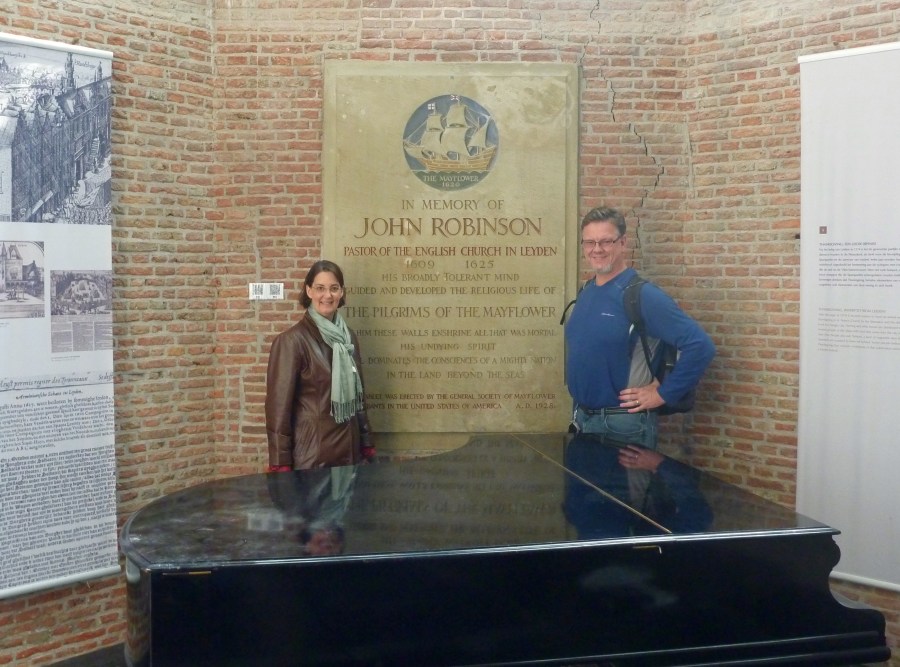
“But now we are all, in all places, stranger’s and pilgrims, travelers, and sojourners…”—Robert Cushman, Pilgrim Leader, 1622. I read these words on April 21, 2015 while visiting the Pieterskerk Cathedral in Leiden, Holland. My interest in and love for the Pilgrims was first whetted when I read Dr. Timothy George’s Harvard dissertation on Pilgrim Father, John Robinson, John Robinson and the English Separatist Tradition, http://www.amazon.com/John-Robinson-English-Separatist-Tradition/dp/0865540438.

You might remember from grade school history that the Pilgrims fled from England to Holland seeking religious liberty. From Holland, they went and settled in what was to become the Plymouth Colony in present day Massachusetts. For this reason, during a recent visit to Leiden, it was only natural that I searched for the historic remnants of the United States’ spiritual “Founding Fathers” in the European city in which they last had residence before sailing to the New World. That search led me to the plaque on the side of the Pieterskerk and the quote with which I started this post. This quote in turns leads me to three simple questions:

  1. What is a pilgrim people?
  2. Why are we a pilgrim people?
  3. How can we be a pilgrim people?

What is a Pilgrim people? Scripture best answers that question in 1 Peter 2: 11 where Christians are described as “aliens and strangers.” 1 Peter 1:17 states clearly that the believer has a limited and brief time while on earth. It speaks of the believer’s “time of your stay on earth.” The ESV actually translates the word “stay” as “exile”, “throughout the time of your exile.” The Reformation Study Bible boldly states, “The Greek word suggests those who live in a place as unnaturalized aliens, and emphasizes the Christian’s temporary, pilgrim status in the world.”

I have lived in Brazil for 23 years. I love the country. I love the people. I love the culture. I love the food. I am very happy there, but I am not a Brazilian. I am a legal alien. I hope to give the best of my life to my missionary calling. However, I realize that there will be an inevitable end to my missionary ministry when I leave Brazil at the end of my missionary service. I am an alien.What is true of some of us politically, Scripture says is true of all us spiritually. The Greek word translated “stay” or exile is Parepidemoi. Dr. Tim Keller notes about this word the following:

Parepidemoi were citizens of one country and yet full-time residents of another. Their primary allegiance was to another country, and that country’s culture was formative for their beliefs and practices. Yet they lived in their country of residence as full participants in its life. In other words, “resident aliens” lived neither as natives nor as tourists. Though they were not permanently rooted, neither were they merely travelers who were just passing through.

The Pilgrim Fathers, and all mature Christians, have always realized that Christians are citizens of two cities: the City of God and the City of Man. As faithful Christians, we love the City of Man. Personally, I love Brazil and I deeply love the United States of America. Still yet, primarily, I am a citizen of the New Jerusalem, the coming eschatological City of God. Thanksgiving is a special time for the Christian to renew his or her commitment to their primary citizenship, the Kingdom of God.

Why are we a Pilgrim people? We have been made not for time, but for eternity. The Pilgrims’ community suffered a devastating loss of life due to the ravages of sickness and starvation upon their first arriving in the New World. It was tragic circumstances, by any account, but not beyond the realm of the possible in the 17th century. For most of human history, humanity has faced a life that is short, painful, and defined by deep suffering. There is reason to give thanks to God for advances in technology and medicine that have allowed so many in this day to experience longer, reasonably health lives. The problem is that often a spirit of humble gratitude is replaced by a sense of arrogant entitlement that feels, “I deserve to live long and prosper”, to roughly paraphrase Mr. Spock’s Vulcan blessing.

It has been said that American Christians are the first generation of Christians no longer to pray, “Maranata. Come Lord Jesus.” For many, life is so good, that some ask, “how could it get better?” The fact is that many faithful Christians worldwide are suffering the ravages of suffering and persecution. Even in the United States, the future cannot be predicted with absolute clarity. Christians are pilgrims because they know there is only one city whose foundations will never crumble, the City of God. While in this world, we love and serve the City of Man, but Christian hope is ultimately fixed on the unwavering firmness of the City of God.

How can we be a pilgrim people? Or stated otherwise, how does one live a Pilgrim’s lifestyle in this world? Much could be said, but I will share with you only a few suggestions:

  • Live with fiscal frugality. You really cannot have it all, so don’t spend like you can. Your check book and your date book reveal your true priorities. Fiscally invest in what truly matters, people and God’s Kingdom.
  • Have focused priorities. Time is a precious commodity. Scripture says “Man knows not his time.” Because it is limited, time needs to be stewarded carefully. Give time to that which is most important: God and your relationship with him, your family, and God’s work both through your local church and the ministries of your local church and in your community.
  • Be guided by Biblical realism. The Bible views this universe as glorious, yet imperfect. Humanity is made in God’s image, the apex of His creation. Yet, human nature is flawed deeply by sin’s all pervasive presence. This means our lives will not always be what we hope in every area: work, relationships, health, and accomplishments. However, the Christian knows that there are certain levels of perfection, attainment, and satisfaction that will never be attained in this world. For this reason, Christians long for the Coming Kingdom of God.
  • Finally, live in the expectation that the Day will come when you see Christ face to face, either as Judge or as Redeemer. The Pilgrim knows that the sorrows of painful good-byes in this world will be comforted and consoled by the joy of eternal “hellos” to be enjoyed in the world that is to come.

With these things in our hearts, life can be faced with resolution, courage, grace, and faith. I conclude with a brief story of my trying to find the grave of the famous John Robinson, Pastor of the Pilgrims in Leiden, Holland. Caron and I entered the Pieterskerk Cathedral looking for Pastor Robinson’s sepulcher. It should be noted that the Pieterskerk Cathedral was decommissioned as a church in 1976. I searched the entire church, but could not find Pastor Robinson’s crypt. Finally, Caron leaned against a piano. Inadvertently, looking underneath it she said, “I think I have found him.” Sure enough, to my surprise, the spiritual father of the United States was hiding underneath a baby grand piano in complete obscurity in the back corner of the church. Sad? Yes, in a sense it is. However, it is not devastating. This is why we are called to be Biblical realists.

The Pilgrim knows that the forgotten saint in this life will be remembered before the throne of God and will hear the words, “Well done good and faithful servant, enter into your Master’s reward.” Happy Thanksgiving to all.

Invest in others, share your story

People often ask me me, “Exactly what is it you do on the mission field?” I smile and think, “Well, where should I begin?”

But really, although I could spend hours telling stories of what life is like, the simple answer is that missionaries invest in the lives of others. Sometimes we teach and train large groups that in turn teach and train other large groups. Other times, we invest in lives one-on-one. Over the years the Lord has brought several such individuals across our paths. Some we have walked with in their “not yet Christian” state. Others, we have had the privilege to help lead to the Lord. Some we have followed up with personal discipleship. A few have lived with us for periods of time, (others have dined with us so often, it was as if they were living with us). We have shared joys and victories, heartbreak and suffering. We have had the privilege of spending time investing in the lives of others. What a blessing!

Is there someone who has invested in your life like this? Is there someone who you are investing in? Some call it intentional discipleship, others call it mentoring. I call it living life together. Isn’t that what Jesus modeled with his disciples? Look around you. Is there someone who needs the little bit of wisdom and experience you have to offer? A dear missionary colleague used to say, “We all have a story to tell”. Perhaps the current chapter of your story is one of grief, or loneliness or suffering. Perhaps it is one of deliverance, or divine protection or grace. Tell your story! Invest in the life of someone else! Only God knows the eternal impact when you share the truth that transforms, one life at a time.

Ready, Set, Go Pray!

Ready, Set, Go Pray!

Do you ever spend so much time thinking about how to begin something that its seems you never get around to actually, well, you know, beginning it? If you are like me (wishing I weren’t quite so much of a perfectionist) its hard to step forward with something new until you feel its “just right”. However, here is what the Lord is teaching me: If I wait until I feel ready, I will never do anything! I never feel totally “ready”. So, with that disclaimer, I now begin, ready or not!

In thinking about what to write for our first real posting, I’ve decided just to begin with what’s on my mind this morning. The topic is PRAYER. I know…you’ve heard about that before. In fact, you probably can recite some “prayers” by heart.

  • “Now I lay me down to sleep….”
  • “God is good, God is great….”
  • “Our Father, which art in heaven, hallowed be thy name….”

But that is not the kind of prayer I am talking about. I’m talking about the kind of prayer that is more like a conversation. You know…the kind where you take turns both speaking and listening.

I’m currently reading the book, Praying the Bible, by Donald Whitney. I’d heard about the book for some time, and have read other books by the same author, so I purchased a copy and settled into my favorite chair with a cup of coffee for a good read. I wasn’t disappointed. However, I did more than read. I prayed! I’m not going to do a book review here, but I do suggest you get a copy and read it for yourself. I think it will transform your prayer life!

So, why am I thinking about prayer so much these days? Several things are going on in our life and ministry, which have caused us to pray more fervently recently.

Many of you know about the Voluntary Retirement Incentive (VRI) that our sending agency, the International Mission Board (IMB) recently announced. Mark and I spent the better part of 6 weeks praying intensely about whether to accept the offer for early retirement and return to the USA or to remain on active career missionary status. With the pulls of family on one continent and ministry on the other, it was not an easy decision! But, we feel God’s peace about our decision to return to Brazil in February, 2016. We prayed for wisdom and peace and God answered our prayers.

What do I mean when I say praying intensely? I mean a focused time of pouring our hearts out to God, expressing our fears and concerns and seeking His will (which He reveals to us through the reading of His word and often, the circumstances He orchestrates around us). It means praising Him for all He has already done and trusting that He knows the future. It is this experience of focused praying, and the reading of the book I mentioned above, that has me thinking more about prayer these days.

As Christmas approaches, Southern Baptists focus on their annual missions awareness emphasis, so we have numerous speaking engagements in the weeks to come. Often we are asked, “How can we pray for you?” What a great question! 🙂

When praying for missionaries it’s really not fundamentally different than praying for yourself, or anyone else you know. Think about these four categories:

  1. Physical
  2. Spiritual
  3. Emotional
  4. Relational

Physical—that’s the one we most often think of. Church prayer lists are full of physical needs of the congregation. When one part of the body is not functioning as it ought, our entire being is affected. We cry out for relief from our pain and our suffering. When you pray for missionaries, pray for physical strength and stamina, the body’s ability to fight off disease and infections, protection from harm (not everyone loves to see an American living abroad) and safety in travels. If we can’t keep going physically we are not as effective in ministry. Pray for the missionaries’ physical surroundings. Pray for the country they serve in and the political climate.

Spiritual—in this category we often jump right to praying for the lost to be saved, as well we should. However, don’t forget to pray for the many intricate parts of that process: the missionary’s daily quiet time and their healthy relationship with their Lord. Missionaries deal with sin in their lives, just like you do. Missionaries need to forgive and seek forgiveness. Pray that your missionaries will not being distracted from the primary tasks of evangelism and discipleship. Pray for opportunities to share the Gospel and for those who are open to hear the message of the Gospel and respond. Pray also for the ability to clearly communicate theological truth in another language and in a culture that distorts and often redefines the message in order to make it more “appealing” or politically correct.

Emotional—your missionaries are not superheroes. We get tired, grumpy, lonely and yes, even discouraged and depressed, just like you do. Every range of emotion you feel your missionaries feel as well. The next time you find yourself frustrated in traffic, pray for a missionary who is stuck in traffic too and probably thinking the same things you are. If you find yourself feeling left out or lonely, pray for a missionary who may be feeling the same thing. If you are apprehensive waiting for test results, remind yourself to trust in the Lord, yes. And also pray that your missionaries will remember that truth too.

Relational—If your missionaries were superheroes (which I have already mentioned they are not), then you would not have to even pray about this. But the truth is, relationships are challenging. Where two or more are gathered, there will be conflict! 🙂 Pray for long distance relationships with extended family members in another country. Pray for relationships between husbands, wives and children. Did you know that many missionaries live in small apartments with private living space being shared with office space, home schooling space, and ministry space? Now add to that the fact that often all members of the family are in the home together for the bulk of the day, day after day (think about that Christmas vacation when you were all snowed in and the kids were restless being home and you were ready for them to be back in school). No matter how much I love working with my husband and having my kids with me, there are days the relationships feel a bit frayed and we all feel we need a bit more space and time away from each other. Pray also for relationships between national colleagues. Just because one studies culture and language doesn’t always mean there is clear understanding. Those misunderstandings can damage relationships if not handled carefully. Even when working with other American colleagues, there can be a difference of opinions that influence the effectiveness of the ministry.

Finally, remember in your prayers don’t just speak to God. Listen! That’s what makes it a conversation, right? As you pray through these categories, read God’s Word—that’s how He speaks to you. Look at the circumstances around you—God may be speaking to you through your circumstances too. Can you begin to see things from a different perspective? Do you notice that there are others around you who would benefit from your prayers as well? Is God speaking to you, not only about your personal prayer life, but also showing you how you can pray for others? Pray for yourself, your family and work/school relationships. Pray for your missionaries. Pray for the lost. Pray for that annoying neighbor or difficult person you know. We all have the same needs. Pray and listen to what God is telling you to do. Then do it. It’s just that simple.

Truth that Transforms

Something new

Bear with us as this is our maiden voyage into the blog world.  For the past 23 years  Mark and Caron and chronicled their lives on mission in Brazil through a periodic newsletter entitled Johnson’s Journal.  This blog is intended to replace that journal.     We invite you to join us here and interact with us.  We look forward to hearing from you!